Binder Constant Climate Chambers: Applications in the Pharmaceutical Industry
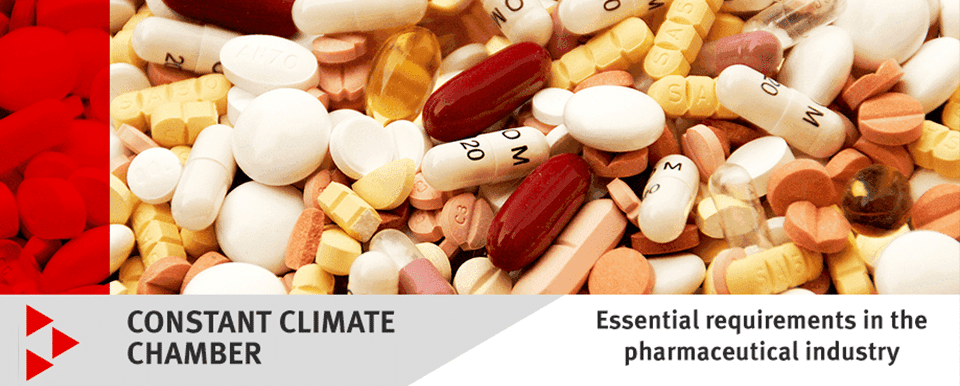
Stability testing of finished pharmaceuticals and drug products must comply with the ICH guideline Q1A (R2) – photostability testing according to Q1B(R2); data from these test methods is critical for submission to regulatory health authorities. In this article, we describe the technical features that are of particular importance in stability testing methods compliant with ICH or other international standards using BINDER climate chambers.
1. Stability testing, photostability, and pharmacological properties of active pharmaceutical ingredients and finished pharmaceutical products
Stability and photostability testing are used to evaluate the medicinal properties of active pharmaceutical ingredients (APIs) or finished pharmaceutical products (FPPs) by altering time, temperature, climate, and light. Conducting these test methods using climate chambers helps determine product expiration dates, retest intervals, and storage conditions. Hoa Viet is currently an official distributor of these climate chambers, also known as accelerated aging chambers (environmental test chambers), for carrying out these studies.
- Constant climate chambers KBF 115, KBF 240, KBF 720, KBF 1020
- Climate chambers with light: KBF P 240, KBF P 720
- Climate chambers with light: KBF LQC 240, KBF LQC 720
- Economical constant climate chambers Solid.Line KBF S115, KBF S240, KBF S720, KBF S1020
The standard Q1A (R2) came into effect in 2003 and Q1B in 1996. As a result, humidity testing has undergone significant developments.
2. Equipment requirements
Accuracy and repeatability of parameters, along with reliability and durability during continuous operation, are the top priorities for a stability test chamber (accelerated aging chamber). An intuitive operating program as well as data and documentation must comply with FDA 21 CFR Part 11 standards. In addition, calibration certificates, data loggers, and qualification/validation documentation packages are also essential.
3. Essential requirements when using climate chambers in Pharmaceuticals
- Temperature – humidity chart
The temperature-humidity chart provides an overview of temperature and humidity values as well as environmental climatic conditions. Binder chambers offer durable performance with negligible temperature deviation, consistently meeting all ICH climatic conditions and capable of simulating all 5 climatic zones from Zone I to IVb. Other chamber lines only simulate specific climatic conditions, resulting in a more limited range of applications compared to Binder climate chambers.
- Horizontal – vertical airflows
In the case of horizontal airflow, air is evenly diffused across any position on each shelf. This distribution direction ensures uniform temperature and humidity throughout the chamber, which is particularly true for dual-sided horizontal airflow. In the case of vertical airflow (from bottom to top), air diffuses through the shelves. Thermal uniformity remains precise even with shelf obstructions.
- Light
When testing samples according to the ICH Q1B standard, light parameters are required in addition to temperature and humidity. The light source and illumination levels depend on the user's needs. VIS light must reach a minimum of 1.2 million lux/hour and UV light must reach a minimum of 200Wh/m2 during the sample testing process.
Even distribution of temperature, humidity, and light across each shelf is of paramount importance. Along with temperature and humidity, lighting must be programmable to comply with FDA 21 CFR Part 11.
- Water for humidifier
Water is a critical component of the humidification system – the water used must be of high quality. There are various ways to supply water: via a direct connection to an on-site water supply, or using a large-volume BINDER water tank supplied as an integrated accessory for water supply and drainage. Alternatively, it can be connected to a remote water source. Whether the water source is located near or far, an ion exchange unit is required to ensure good water quality before supplying the chamber.
- Continuous operation
BINDER climate chambers (pharmaceutical shelf-life test chambers) can operate continuously for 8,000 h/year. Powerful operation, durable materials, and high-quality internal components ensure maximum reliability and long-term use over many years. To reduce the risk of cross-contamination and biological contamination inside the chamber, the manufacturer designed the unit for easy cleaning and maintenance. It features stainless steel alloy construction with rounded corners, autoclavable shelves, and no synthetic materials inside. Certain series also feature an extended temperature range up to 100°C, enabling sterilization.
- Programming and documentation
A key factor for application acceptance is complete documentation of all parameters across all operating states. Documentation must comply with 21 CFR Part 11 for electronic records and signatures. Essential certificates include calibration for temperature, climate, and light, data loggers (independent data logging process documentation), and validation documentation with IQ (Installation Qualification), OQ (Operational Qualification), and PQ (Performance Qualification).
4. Other important guidelines: WHO, FDA, MHW, and VICH
Other important guidelines have been published by the World Health Organization (WHO): Stability testing of active pharmaceutical ingredients and finished pharmaceutical products. Guidelines have also been published by the following organizations: the US Food and Drug Administration (FDA) in the United States, the European Medicines Agency (EMEA), and the Ministry of Health and Welfare (MHW) in Japan.
For active pharmaceutical ingredients in veterinary medicinal products, VICH GL3 (R) "Stability Testing of New Veterinary Drug Substances" and VICH GL5 "Photostability Testing of New Drug Substances and Medicinal Products in Veterinary Medicine" describe the corresponding stability testing.